
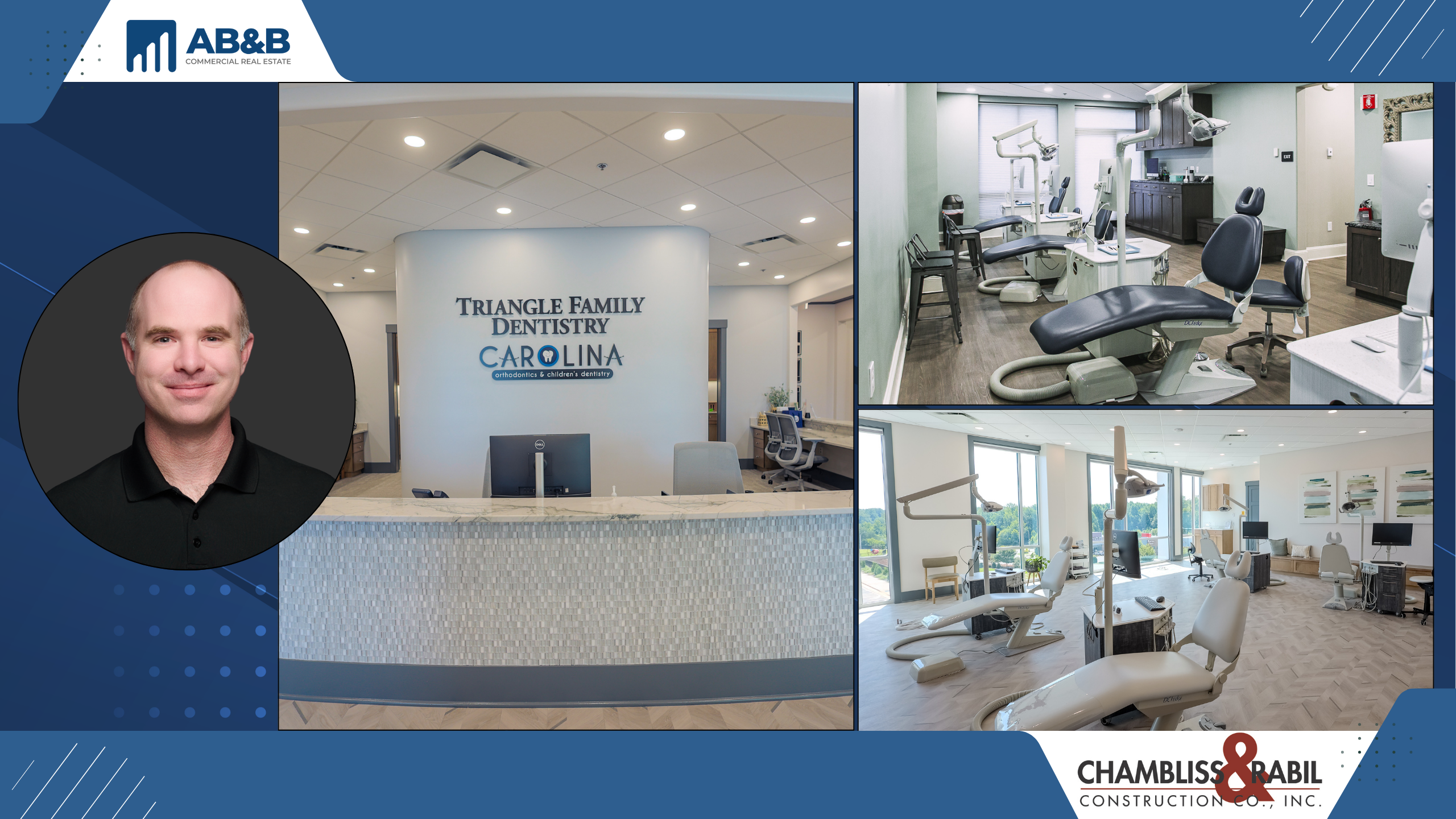
The Cross Pollination Effect: Why AB&B Builds Alongside the Partners It Grows With

June 18, 2026

In most commercial real estate, the general contractor walks onto a project after the plans are drawn, the budget is set, and the design decisions have already been made. Their job is to build what someone else figured out.

That model works well enough most of the time. It also leaves a lot of value on the table, and creates a lot of room for things to go wrong.

AB&B has spent more than a decade operating under a different model, one where the construction partner is at the table from the very first conversation about a piece of land. Before the offer goes in. Before the pro forma is finalized. Before the design team has a finished concept. The construction partner is helping evaluate whether the project should happen at all.

That partner is Chambliss & Rabil, the Raleigh-based general contractor that has built nearly every ground-up development AB&B has ever delivered.

A Relationship That Started Before AB&B Was AB&B

The first project AB&B ever developed was a ground-up build on Briar Creek Parkway in Raleigh. It was also the first project AB&B did with Chambliss & Rabil. From that first build forward, every ground-up development in AB&B’s portfolio has come through the C&R partnership.

Chris Dougherty is now a full owner and Vice President at C&R, where he has spent the last 18 years. He oversees the firm’s Raleigh division and leads pre-construction and operations. He also personally runs point on the majority of AB&B’s projects, by choice.

“Our two companies have experienced parallel trajectories of growth,” Chris says. “That is not a coincidence. They have been loyal clients and trusted mentors.”

How the Partnership Works

Most general contractors hear about a property after the developer has already bought it. C&R hears about it before AB&B has even decided whether to make an offer.

When AB&B identifies a site that meets its acquisition criteria, Chris is one of the first calls. The conversations cover end users, intended scope, and the construction feasibility of the parcel. C&R provides cost projections for site work and the building itself. Those numbers flow into AB&B’s pro forma. If the math works, the project moves forward.

From there, Chris stays involved through every phase, providing ongoing feedback on constructability, materials selection, pricing, and coordination.

Every month, the people responsible for each AB&B development project meet on a single call. The roster reflects how many disciplines have to align for a project to actually work. AB&B’s co-founders bring two distinct lenses. Dr. Jonathan Boes brings deep construction knowledge and a developer’s instincts for how a project comes together from the ground up. Dr. Hesham Baky brings strategic vision and a medical tenant’s perspective on where AB&B builds and for whom. COO Jimmy Ricard ensures that direction translates into execution. Asset Manager Brett Earp holds the long-range portfolio view of how each project performs and how tenant mix interacts across the wider portfolio. Construction Project Manager Cindy Cohen tracks day-to-day realities across every property in progress. Chris brings the construction lens: what is buildable, what materials will perform, and what realistic timelines and costs look like. Architect Richard Redfoot translates vision into design that holds up for tenants over time. The civil engineering team from VHB owns the site work, from grading and stormwater to utilities and jurisdictional compliance. Leasing joins when there is something to contribute. Strategic Operations Coordinator Jel captures every decision in AB&B’s project management platform so nothing falls through the cracks.

“It’s far more collaborative with a lot more players involved than it used to be,” Chris says.

Every voice in the room exists to catch something the others might miss. The asset manager might see a portfolio-level concern the architect could not. The contractor might flag a constructability issue the developer might not anticipate. Leasing might bring forward emerging tenant interest that shapes how a space gets configured before the design is finalized. The collaboration keeps any one discipline from making a decision in a vacuum, and each project sharpens what the next one catches sooner.

For tenants, the result of all that coordination is invisible by design. They walk into a space where the layout works for their business, the infrastructure supports what they need, and the timeline they were promised is the timeline they got. The surprises that should have been caught in design were caught in design.

What the Integrated Model Protects Against

The clearest proof of the model is the one project where the model was not used.

On one outlier development, AB&B was required to use an outside design team as a condition of the land purchase, and was strongly encouraged to use an outside general contractor as well. The outside GC had no involvement in the design conversations. The outside design team had no working knowledge of what AB&B’s medical office tenants actually need.

The result was a building shell that lacked the basics. No clear provisions for tenant power. No water access. No rated corridors between spaces. No utility path between floors.

C&R was eventually brought in to handle the tenant fit-outs on the second floor, and spent significant effort resolving the oversights left behind in the shell.

“That was a prime example of how not to do it,” Chris says. “And that was very atypical of any other AB&B development project, which I think speaks volumes to how the other projects have been done and why they’re successful.”

The lesson confirmed what AB&B already believed. Every ground-up development since has been delivered through the integrated model.

Why Tenants Feel the Difference

The integrated model also extends into tenant fit-out work. C&R routinely builds out spaces for AB&B tenants beyond the anchor users, which produces three efficiencies tenants experience directly.

First, cost. Because C&R is already on site for the shell construction, the overhead and mobilization costs that would otherwise show up in a separate contractor’s bid are largely absorbed.

Second, speed. Fit-up can begin earlier, often while shell construction is still wrapping up. That compresses the timeline between lease signing and the day a tenant opens for business.

Third, expertise. C&R’s specialty is medical construction, which is also the predominant tenant profile across AB&B’s portfolio. A medical practice working with C&R is working with a builder who already understands the specific demands of the space.

At The Glennon, the AB&B development currently in permitting in Wendell, C&R will build out Triangle Family Dentistry‘s space. They are also in active conversations with the tenant taking the balance of the building.

What Comes Next

C&R is currently building New Hill, one of AB&B’s most technically complex ground-up projects to date. Two additional ground-up developments, The Glennon and Knightdale Station, are working through permitting. All three projects include Triangle Family Dentistry as the anchor tenant.

The biggest news from C&R’s side is forward-looking. After more than a decade of operating across three North Carolina locations covering roughly 75% of the state, C&R is officially expanding into South Carolina. The decision was driven in large part by AB&B’s continued growth.

“If they have a need that’s outside of our normal footprint, we’re going to service that,” Chris says.

That kind of commitment from a development partner is rare. Most contractors stay where their existing infrastructure already operates. C&R is following AB&B into a new market because the partnership has earned that level of investment.

The Beehive in Action

AB&B’s Beehive Philosophy is built on the idea that sustainable growth comes from the strength of the partners that surround the business. The thesis only holds if the partners actually grow alongside the company. Not every relationship clears that bar over a decade. The ones that do are chosen with intention.

When asked what he is most proud of about the relationship, Chris’s answer was direct.

“Ten years ago, I never would have fathomed how aligned we would be, how they want to do things the right way, how their word is bond, how they put value on people,” he says. “A lot of that growth has run in tandem. All ships rise with the tide.”

Dr. Jonathan Boes, Co-Founder and Director of Development at AB&B, echoes that sentiment.

“Chris has been part of our team since before we knew what AB&B was going to become. The reason we keep working with Chambliss & Rabil is the same reason we built AB&B the way we did. We surround ourselves with people who hold themselves to a higher standard than we ask them to. Chris and his team have done that every day for more than a decade.”

What sits behind the partnership is something simpler than a system or a process. Near the end of our conversation, Chris put it plainly.

“Hesham and Jonathan are hands down my favorite clients,” he said. “We can talk to each other openly, honestly. I don’t feel the need to tiptoe around things. I can speak my mind, and whether they agree or not, that’s fine. And same thing in reverse.”

That kind of trust does not show up in a pro forma or a permit application. It shows up in every building C&R has helped AB&B deliver, and it will show up in every one yet to come.